
Description
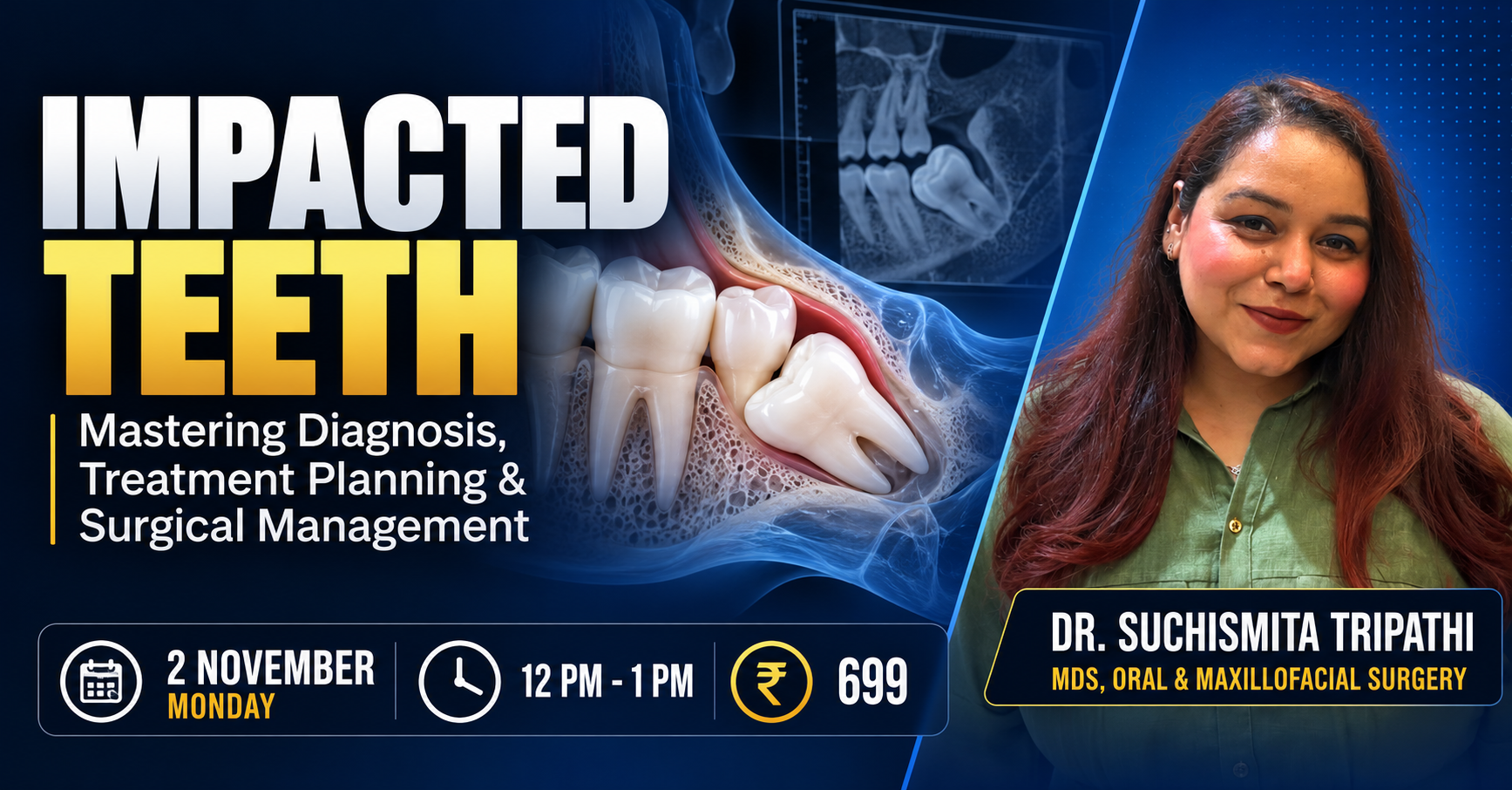
From accurate diagnosis to confident surgical management — build a systematic approach to managing impacted teeth.
Impacted teeth, particularly third molars, are among the most common challenges encountered in dental practice. However, successful management involves much more than simply removing a tooth. It requires accurate clinical and radiographic assessment, careful evaluation of surgical difficulty, appropriate treatment planning, and sound surgical technique.
When should an impacted tooth be removed, and when is observation appropriate? How do you assess the difficulty of an impaction? Which radiograph is best suited for a particular case? And how can you minimize complications during surgical removal?
This webinar will help you approach impacted teeth systematically, with a focus on diagnosis, treatment planning, surgical principles, and the management of mandibular and maxillary third molar impactions through practical clinical insights and case-based discussions.
🎯 Why This Topic Matters
Effective management of impacted teeth can help dentists:
🦷 Make informed decisions about observation versus surgical intervention
🔍 Improve diagnostic accuracy through appropriate clinical and radiographic assessment
📊 Assess surgical difficulty and identify potential risks before operating
🛠 Understand the principles of safe and systematic surgical removal
⚠️ Reduce avoidable surgical errors and complications
🤝 Improve patient care through appropriate case selection and treatment planning
A structured approach to disimpaction helps bridge the gap between theoretical knowledge and real-world surgical decision-making.
📚 What You Will Learn
🦷 Understanding Impacted Teeth
✔ Definition and classification of impacted teeth
✔ Etiology and pathogenesis of impaction
✔ Commonly impacted teeth
✔ Indications for treatment
✔ When to observe and when to intervene
🔍 Clinical & Radiographic Assessment
✔ Clinical examination of impacted teeth
✔ Radiographic evaluation and interpretation
✔ IOPA, OPG and CBCT — when to use which investigation
✔ Assessment of tooth position and angulation
✔ Relationship with adjacent teeth and vital anatomical structures
✔ Preoperative risk assessment and identification of potential complications
🦷 Impacted Mandibular Third Molars
✔ Classification of mandibular third molar impactions
✔ Winter’s classification
✔ Pell & Gregory classification
✔ Assessment of surgical difficulty
✔ Surgical case selection
✔ Treatment planning based on impaction characteristics and clinical findings
🛠 Surgical Principles & Techniques
✔ Essential surgical armamentarium
✔ Patient preparation and local anaesthesia
✔ Principles of flap design
✔ Bone guttering and tooth sectioning
✔ Elevation and delivery of impacted teeth
✔ Wound irrigation and closure
✔ Suturing principles
✔ A systematic approach to surgical removal
🦷 Impacted Maxillary Third Molars
✔ Clinical and radiographic assessment
✔ Selection of the appropriate surgical approach
✔ Important anatomical considerations
✔ Management of difficult maxillary third molar impactions
✔ Understanding and preventing maxillary tuberosity fracture
✔ Risk awareness during maxillary third molar surgery
📋 Clinical Case Discussions
✔ Case-based treatment planning
✔ Systematic interpretation of OPGs
✔ Choosing the appropriate surgical approach
✔ Differentiating simple and difficult impactions
✔ Recognizing common surgical mistakes
✔ Practical clinical tips and tricks
✔ Interactive discussion and Q&A
🎁 Bonus Session
10 Common Mistakes During Wisdom Tooth Surgery — And How to Avoid Them
✔ Identify common errors encountered during wisdom tooth surgery
✔ Understand why these mistakes occur
✔ Learn practical strategies to minimize avoidable complications
🎯 By the End of This Webinar, You Will Be Able To:
✅ Understand the classification and clinical significance of impacted teeth
✅ Select appropriate radiographic investigations for different clinical situations
✅ Assess the position, angulation and difficulty of impacted third molars
✅ Make more informed decisions regarding treatment planning and surgical case selection
✅ Understand the fundamental steps involved in mandibular and maxillary third molar surgery
✅ Recognize potential surgical risks and apply strategies to help prevent complications
✅ Apply a more systematic approach to evaluating and managing impacted teeth using clinical cases
👩⚕️ About the Speaker
Dr. Suchismita Tripathi
MDS – Oral & Maxillofacial Surgery
Dr. Suchismita Tripathi is an Oral & Maxillofacial Surgeon with clinical experience in dentoalveolar surgery and the management of impacted teeth.
With a strong focus on practical, patient-oriented surgical care, she aims to bridge the gap between textbook knowledge and real-world clinical decision-making.
Through this webinar, she will share a structured approach to the diagnosis, radiographic assessment, treatment planning and surgical management of impacted teeth. Clinical cases and practical insights will help participants understand the considerations involved in managing different types of impactions and minimizing surgical complications.
👥 Who Should Attend?
👨⚕️ General Dentists
🦷 Oral & Maxillofacial Surgeons
🎓 BDS Interns and Undergraduate Students
📚 MDS Students in Oral & Maxillofacial Surgery
🩺 Dental Practitioners performing or planning to perform third molar surgery
🔍 Clinicians looking to strengthen their diagnostic, treatment-planning and surgical decision-making skills